21.06.2021
Uzbekistan
Damir Mukhetdinov presented Russian theology at the international symposium " The Teaching of Maturidism and Modernity»
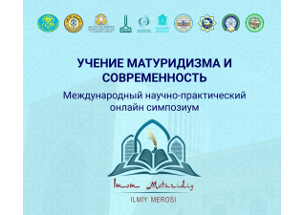
On 16th of June, 2021, Acting Chairman of the Religious Board of Muslims of the Russian Federation, Executive Secretary of the Muslim International Forum, Doctor of Theology Damir Mukhetdinov took part in the scientific and practical online symposium "The Teaching of Maturidism and Modernity", organized by the International Islamic Academy of Uzbekistan.
The large-scale conference brought together representatives of dozens of world scientific and educational centers, including ICESCO, IRCICA, the Malaysian Institute of Islamic Studies, the International Academy of Islam of the Al-Azhar Complex, the Maturidi Research Center of Seljuk University, the Center for Islamic Civilization in Uzbekistan, the International Research Centers of Imam Bukhari and Imam Tirmizi, as well as others.
Leading theologians and Islamic scholars from Egypt, Jordan, Turkey, Germany, Sweden, France, Bosnia and Herzegovina, Russia, Malaysia, Uzbekistan, Kyrgyzstan, Kazakhstan and Afghanistan exchanged expert opinions and scientific results.
In his report on the possibilities of modern research of Maturidism, D. Mukhetdinov considered the methodology of teaching as a factor in the emerging return of theology to the general complex of academic science and the development of theological research in our days.
"Maturidi makes his evidence base on the basis of rationalism, speaking of Divine Wisdom, that God Himself acts according to wisdom. This gives us the basis for the statement that faith cannot contradict science, " he emphasizes. - The ratio of faith and deeds determined by the Maturidites is especially relevant for the era of both post-Soviet atheistic society, which has not yet had time to revive the true spirit of faith and traditions, and postmodernism with the features of the secular nature of states. This division provides a broad platform and basis for pluralistic, tolerant, tolerant attitudes towards others."
Mukhetdinov also emphasizes that Maturidism is a traditional concept for Russian theological thought, and an appeal to its heritage will allow the Russian Ummah to contribute to the formation of both an intra-confessional and inter-religious agenda based on reason, wisdom and relevance.:
"Maturidism is the heritage of Russian Muslims. It was on Hanafism in jurisprudence and Maturidism in theology that the life activities of our fathers and mothers, educational and religious centers and schools were built. In the correlation between the rationalism of Abu Hanifa and the rationalism of Abu Mansur al-Maturidi, we have the strongest argument for the success of the theological, philosophical, and legal thought of Islam, leaving these schools with the primacy and leadership."
Taking into consideration the approach of a significant date for Russian Muslims – the 1100th anniversary of the adoption of Islam by the peoples of Volga Bulgaria, which will be celebrated at the state level in the country in 2022 – the report announced a large-scale international project initiated by the chairman of the Religious Board of Muslims of the Russian Federation, Mufti Sheikh Ravil Gaynutdin.
We are talking about the creation of an interdisciplinary academy "Bayt al-Hikma"("House of Wisdom"). It is a large platform for translating, commenting, publishing, and writing works in the sphere of Islamic thought. The name is an allusion to the project implemented in the first half of the IX century to integrate ancient philosophical and scientific literature, that is, the bulk of the scientific knowledge that existed at that time, into the Islamic intellectual tradition.
At the moment, work has already been launched to prepare for publication the works of famous representatives of classical Islamic thought-Abu Hanifa, at-Tahawi, Abu Mansur al-Maturidi, Najm al-Din al-Nasafi, Nur al-Din al-Sabuni, etc.
In conclusion, Damir Mukhetdinov noted that in the modern scientific field, Oriental and Islamic studies are already closely intertwined with traditional Islamic knowledge, and the leading orientalists are often Muslims themselves. In the process of developing the project, it is useful to take into account the achievements of Russian and Western experts, since scientific Oriental studies-as a synthesis of science and tradition-can provide researchers with the most accurate, competent and relatively neutral knowledge about Islam:
"We see the prospect of Maturid studies in the reconciliation and development of both traditions – confessional and academic. Al-Maturidi did not limit himself to repeating the transmitted teachings in their traditional formulations. He tried to prove everything he taught, and deduced new theses from what was previously stated. And today we must develop our faith and our scholarship according to the methodology laid down by Abu Hanifa and Abu Mansur al-Maturidi, subjecting our views to rational inspection. Indeed, " to all people who have been given reason, tawhid is also given in its
The large-scale conference brought together representatives of dozens of world scientific and educational centers, including ICESCO, IRCICA, the Malaysian Institute of Islamic Studies, the International Academy of Islam of the Al-Azhar Complex, the Maturidi Research Center of Seljuk University, the Center for Islamic Civilization in Uzbekistan, the International Research Centers of Imam Bukhari and Imam Tirmizi, as well as others.
Leading theologians and Islamic scholars from Egypt, Jordan, Turkey, Germany, Sweden, France, Bosnia and Herzegovina, Russia, Malaysia, Uzbekistan, Kyrgyzstan, Kazakhstan and Afghanistan exchanged expert opinions and scientific results.
In his report on the possibilities of modern research of Maturidism, D. Mukhetdinov considered the methodology of teaching as a factor in the emerging return of theology to the general complex of academic science and the development of theological research in our days.
"Maturidi makes his evidence base on the basis of rationalism, speaking of Divine Wisdom, that God Himself acts according to wisdom. This gives us the basis for the statement that faith cannot contradict science, " he emphasizes. - The ratio of faith and deeds determined by the Maturidites is especially relevant for the era of both post-Soviet atheistic society, which has not yet had time to revive the true spirit of faith and traditions, and postmodernism with the features of the secular nature of states. This division provides a broad platform and basis for pluralistic, tolerant, tolerant attitudes towards others."
Mukhetdinov also emphasizes that Maturidism is a traditional concept for Russian theological thought, and an appeal to its heritage will allow the Russian Ummah to contribute to the formation of both an intra-confessional and inter-religious agenda based on reason, wisdom and relevance.:
"Maturidism is the heritage of Russian Muslims. It was on Hanafism in jurisprudence and Maturidism in theology that the life activities of our fathers and mothers, educational and religious centers and schools were built. In the correlation between the rationalism of Abu Hanifa and the rationalism of Abu Mansur al-Maturidi, we have the strongest argument for the success of the theological, philosophical, and legal thought of Islam, leaving these schools with the primacy and leadership."
Taking into consideration the approach of a significant date for Russian Muslims – the 1100th anniversary of the adoption of Islam by the peoples of Volga Bulgaria, which will be celebrated at the state level in the country in 2022 – the report announced a large-scale international project initiated by the chairman of the Religious Board of Muslims of the Russian Federation, Mufti Sheikh Ravil Gaynutdin.
We are talking about the creation of an interdisciplinary academy "Bayt al-Hikma"("House of Wisdom"). It is a large platform for translating, commenting, publishing, and writing works in the sphere of Islamic thought. The name is an allusion to the project implemented in the first half of the IX century to integrate ancient philosophical and scientific literature, that is, the bulk of the scientific knowledge that existed at that time, into the Islamic intellectual tradition.
At the moment, work has already been launched to prepare for publication the works of famous representatives of classical Islamic thought-Abu Hanifa, at-Tahawi, Abu Mansur al-Maturidi, Najm al-Din al-Nasafi, Nur al-Din al-Sabuni, etc.
In conclusion, Damir Mukhetdinov noted that in the modern scientific field, Oriental and Islamic studies are already closely intertwined with traditional Islamic knowledge, and the leading orientalists are often Muslims themselves. In the process of developing the project, it is useful to take into account the achievements of Russian and Western experts, since scientific Oriental studies-as a synthesis of science and tradition-can provide researchers with the most accurate, competent and relatively neutral knowledge about Islam:
"We see the prospect of Maturid studies in the reconciliation and development of both traditions – confessional and academic. Al-Maturidi did not limit himself to repeating the transmitted teachings in their traditional formulations. He tried to prove everything he taught, and deduced new theses from what was previously stated. And today we must develop our faith and our scholarship according to the methodology laid down by Abu Hanifa and Abu Mansur al-Maturidi, subjecting our views to rational inspection. Indeed, " to all people who have been given reason, tawhid is also given in its