10.08.2021
Cairo (Egypt)
Pharaoh Khufu's boat was brought to the Grand Egyptian Museum
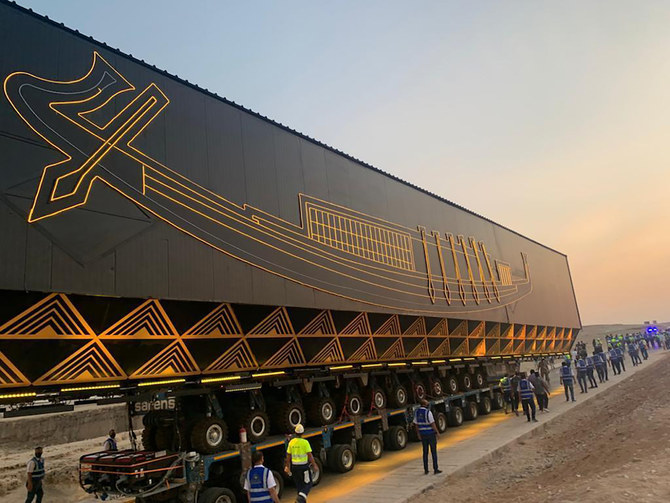
In a solemn procession, the Grand Egyptian Museum (GEM) received the boat of Pharaoh Khufu. For more than four centuries, the boat was located in a special museum located on the southern side of the Great Pyramid of Khufu on the Giza Plateau.
The project will preserve what experts have described as the largest, oldest and most important relic in the history of mankind.
A smart remote-controlled trolley was specially brought from Belgium to transport the boat without disassembling it. The process took about 10 hours, covering 8 km from the boat's location to the destination.
The boat will be displayed on a special platform with an area of 1400 square meters. in the outer courtyard near the Grand Egyptian Museum.
Atef Moftah, the chief scientific officer of the GEM, said that the process of transferring the boat was “one of the most important, complex and unique archaeological engineering projects,” stressing that the task force did not leave anything to chance.
He said that the special transport that carried the boat could overcome any obstacles on the road, maneuvering on difficult turns and absorbing any vibrations.
Mostafa Waziri, head of the Supreme Council of Antiquities (SCA), said that the process was approved by the Standing Committee on Antiquities of Egypt in accordance with the Law on the Protection of Antiquities.
Al-Tayeb Abbas, Assistant Minister of Tourism and Antiquities, said that a radar survey of the rocky ground was carried out before transportation to ensure its ability to withstand weight.
He also added that an outstanding team of restorers from GEM conducted a laser scan of the boat to document its most accurate details and pack it for transportation.
Known in the media as the solar boat, it was made of cedar wood imported from Lebanon.
Many people said that the ancient Egyptians made this boat for the king so that he could use it in his daily trips with the sun god Ra, while others claimed that the boat was used to transport the king's body from the east bank of the Nile to the west bank, where he was buried.
The museum where the boat was located was not equipped to store the wooden artifact, as the organic structure began to collapse. Transporting the boat to a new location was extremely necessary.
Many ideas for moving the boat were considered. All of them included the dismantling of the boat and its reconstruction in the "GEM", but were discarded due to the risk of its deformation.
Moving the 42-meter and 20-ton boat safely was the only suitable solution, such as transporting the colossus of Ramses II from Ramses Square to the Grand Museum.
In preparation for the transfer, the GEM and SCA working group conducted three simulations using a remote-controlled car.
Then the boat was packed with special scientific foam and placed in an iron cage for protection
The project will preserve what experts have described as the largest, oldest and most important relic in the history of mankind.
A smart remote-controlled trolley was specially brought from Belgium to transport the boat without disassembling it. The process took about 10 hours, covering 8 km from the boat's location to the destination.
The boat will be displayed on a special platform with an area of 1400 square meters. in the outer courtyard near the Grand Egyptian Museum.
Atef Moftah, the chief scientific officer of the GEM, said that the process of transferring the boat was “one of the most important, complex and unique archaeological engineering projects,” stressing that the task force did not leave anything to chance.
He said that the special transport that carried the boat could overcome any obstacles on the road, maneuvering on difficult turns and absorbing any vibrations.
Mostafa Waziri, head of the Supreme Council of Antiquities (SCA), said that the process was approved by the Standing Committee on Antiquities of Egypt in accordance with the Law on the Protection of Antiquities.
Al-Tayeb Abbas, Assistant Minister of Tourism and Antiquities, said that a radar survey of the rocky ground was carried out before transportation to ensure its ability to withstand weight.
He also added that an outstanding team of restorers from GEM conducted a laser scan of the boat to document its most accurate details and pack it for transportation.
Known in the media as the solar boat, it was made of cedar wood imported from Lebanon.
Many people said that the ancient Egyptians made this boat for the king so that he could use it in his daily trips with the sun god Ra, while others claimed that the boat was used to transport the king's body from the east bank of the Nile to the west bank, where he was buried.
The museum where the boat was located was not equipped to store the wooden artifact, as the organic structure began to collapse. Transporting the boat to a new location was extremely necessary.
Many ideas for moving the boat were considered. All of them included the dismantling of the boat and its reconstruction in the "GEM", but were discarded due to the risk of its deformation.
Moving the 42-meter and 20-ton boat safely was the only suitable solution, such as transporting the colossus of Ramses II from Ramses Square to the Grand Museum.
In preparation for the transfer, the GEM and SCA working group conducted three simulations using a remote-controlled car.
Then the boat was packed with special scientific foam and placed in an iron cage for protection